• Platform
        • PLATFORM

          AI-powered retail returns prevention

        • Platform Overview

          Unlock returns intelligence

          Capabilities

          See how Returnalyze works

          Setup & Onboarding

          Easy to set up, easy to use

          Use Cases

          Built for retail teams

        • Read case study ➜

  • Results
        • RESULTS

          Achieve more
          profitable growth


        • Profit Drivers

          Uncover hidden profit levers

          Value Plays

          Elevate cross-functional wins

          Measured Impact

          See what fixing returns is worth

          Customer Stories

          Validate the ROI

        • Read case study ➜

  • Resources
        • RESOURCES

          Better retail margins
          start here


        • Returnalyze Blog

          Find your next insight

          Newsroom

          Catch up on what's new

          Customer Stories

          Learn from top brands

          Briefs & Reports

          Get to know Returnalyze

        • Read case study ➜

  • Book a Meeting
  • Company
        • COMPANY

          Born from retail.
          Built for scale.


        • About Us

          Discover what sets us apart

          Leadership Team

          Meet the leaders driving change

          Investors & Advisors

          See who powers our growth

          Partners

          Explore our solution ecosystem

        • Read case study ➜

  • Solutions
        • SOLUTIONS

          Reduce returns where
          they hit the hardest


        • Apparel & Footwear

          High-returning styles

          Luxury Goods

          Expectation shortfalls

          Home & Living

          Color, scale and quality

          Consumer Electronics

          Feature gaps and compatibility

        • Read news release ➜

  • Sign In
  • Menu Menu
  • Platform
  • Results
  • Resources
  • Book a Meeting
  • Company
  • Solutions
  • Sign In

The Role of Returns Analytics in 2024 Retail Trends

December 15, 2023/by Returnalyze

Between AI innovations and changing consumer behaviors, data will be king in 2024. Discover the vital role returns data will play in upcoming retail trends.

While trends and technological innovations can sometimes surprise us, staying on top of retail predictions is still essential for brands and retailers currently elbow-deep in strategy for 2024. The name of the game moving forward? AI-driven decisions, advanced algorithms, and machine learning—and returns data will play a huge role.

One could even argue that because returns is a lagging indicator, it provides the most holistic view of performance. Even when return rates are low, data from these transactions gives us a deeper understanding of consumer behavior, marketing, product performance, supply chains, and so much more.

This kind of granular data allows you to make more informed decisions regarding every aspect of business. Learn about the role of returns analytics in upcoming retail predictions, plus how incorporating returns data into your 2024 strategies can improve net revenue.

Returns Analytics Will Aid Data-Driven Personalized Shopping Journeys

Both retailers and customers benefit when the shopping journey is tailored to individuals. For shoppers, it becomes easier to find their ideal product amidst an abundance of choices. For retailers, this means higher conversion rates and higher customer lifetime value.

According to Think With Google, “People are 40% more likely to spend more than planned when they identify the shopping experience to be highly personalized.”


While this type of personalization may have seemed like a luxury in the past, the rise of AI will likely make these practices standard procedure moving forward. Retailers can harness AI’s advanced algorithms and large language models to analyze massive amounts of data, uncover valuable insights, and develop targeted strategies.

Amazon’s AI-powered recommendation engine is a good example of this. By analyzing vast amounts of data (browsing behavior, demographic information, purchase history, etc.), Amazon can recommend products that are tailored to individuals. This level of personalization boosts customer satisfaction, increases loyalty, and increases sales.

Modern consumers have come to expect personalized product recommendations, individualized offers, and even customized marketing messages. One survey published by Statista found that 62 percent of respondents “stated that a brand would lose their loyalty if it delivered a non-personalized experience. A year earlier, the share stood at 45 percent.”

What’s more, returns data provides valuable insights that can enhance personalized shopping strategies. In the past, retailers may have equated the “sale” with the “finish line” of the buyer’s journey. Today, however, we know that post-purchase activity is just as vital.
 

After a purchase, shoppers may purchase again, leave reviews, or they may return an item for a variety of reasons. For example, while browsing behavior may indicate a shopper will purchase certain products, that doesn’t mean they won’t return them. Not only can returns analytics help us understand their product return reasons, but it can also provide insights that can optimize personalized shopping strategies.

Additionally, comparing returns analytics from behaviors like bracketing can reveal product recommendation opportunities. Imagine many shoppers bracket a garment in multiple colors while maintaining a high keep rate. In this instance, it may be advantageous to recommend an additional color to shoppers who have added a single variation to their cart.

That’s just the beginning. Returns data can help personalize loyalty programs, shopping journeys across different sales channels, and so much more.

Returns Analytics Will Improve Omnichannel Sales and Enhance Multi-Channel Insight

The state of multi-channel sales is evolving, and that’s a good thing. However, it’s difficult to fully grasp net revenue and marketing ROI from individual channels without taking returns data into account.

Customers want seamless, adaptive experiences regardless of whether they’re shopping on a brand’s website, social media, or even in-store. And returns analytics can be used to improve experiences and sales across channels in several ways. For example, identifying channel-specific issues is vital for the consumer experience. Whether the issue lies in the product descriptions, returns abuse, images, or even sizing charts, returns analytics helps identify these kinds of channel-specific issues so product returns can be reduced and net profits across channels can grow.

Consumers have even begun using multiple channels at one time. Earlier this year, Shopify said, “50% percent of consumers say videos have helped them figure out what product or brand to buy, and 55% of consumers say they watch videos while shopping in-store.” Clearly, the buying process is more complex than ever before, and retailers need to use data to anticipate consumer needs.

Chris Cantino, of investment and consulting firm Color, told Shopify, “Companies who embrace multiple sales channels will pursue analytics that inform a more holistic view of customer journeys, which may transition from online to offline and back again.”


As multiple sales channels create a more dynamic buying journey with options like BORIS (buy online, return in-store) and BOPIS (buy online, pick up in-store), verifying which channels and touchpoints convert and lead to net revenue is essential. Top-line sales alone aren’t enough to determine whether a sales channel is successful. That’s why incorporating returns analytics is an important aspect of omnichannel sales and marketing strategies.

Consumer Insights from Returns Analytics Will Be Vital for Increased Social Sales

The merging of e-commerce and social media is here to stay. Between social networks offering in-app purchases, influencer marketing, shoppable posts, and in-app storefronts, it’s easier than ever for users to discover new products, new brands, and to make purchases without leaving the platform.

Insider Intelligence said, “Next year, US retail social commerce sales will total $82.82 billion, growing 23.5% YoY, per our forecast.”


The consumer insights from returns data will be particularly beneficial for social sales. It can help inform influencer marketing strategies by identifying individuals with both high and low customer return rates, it can help you understand the performance of certain SKUs or brands, and it can even be used to cross-reference returns data across channels to verify issues.

Open-ended feedback in the form of reviews and return comments is of particular importance in this instance. Analyzing customer feedback from returned social sales can reveal valuable qualitative insights that not only highlight specific issues but also create opportunities for loyalty. When shoppers know that retailers or brands will address their concerns, it creates a connection that can lead to brand advocacy and a greater lifetime value.

Harness Returns Data For Additional Revenue in 2024

The data from your product returns tells an important story about current and prospective customers, your products, marketing, and more. That’s why analyzing this data is so vital. You just need the right analytics tools.

The Returnalyze Intelligent Dashboard provides the detailed information necessary to understand and leverage customer behaviors, optimize product assortment, save on inventory management, and so much more. Essentially, the granular data you’ll gain access to will allow you to identify opportunities that may have otherwise gone unnoticed… and in 2024, you won’t have to do this alone.

A partnership with Returnalyze comes with step-by-step guidance from our expert data analysts. We’ll work with you to leverage returns data in order to identify issues, opportunities, and develop data-driven solutions that increase your net revenue.

Partner with us in 2024 to increase revenue with returns data. Schedule a demo or contact our team today.
https://www.returnalyze.com/wp-content/uploads/shutterstock_2320209563.jpg 800 1200 Returnalyze https://www.returnalyze.com/wp-content/uploads/returnalyze-logo-updated-blackbg.svg Returnalyze2023-12-15 09:00:002026-05-20 09:18:02The Role of Returns Analytics in 2024 Retail Trends

The Power of Policies: How Return Policy Shapes Returns and Sales

December 12, 2023/by Returnalyze

Follow these key elements to create a successful return policy.

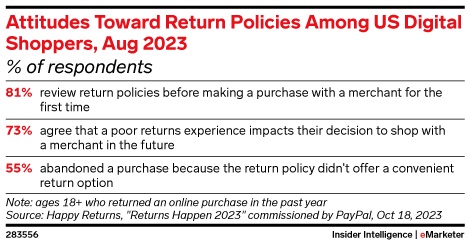
In the dynamic landscape of e-commerce and retail, a company’s return policy plays a pivotal role in shaping customer satisfaction, influencing purchasing decisions, and ultimately impacting both returns and sales. A well-crafted return policy is not merely a set of rules but a strategic tool that can enhance customer trust, boost brand loyalty, and drive revenue. In this blog post, we will delve into the intricate relationship between a company’s return policy and its effects on returns and sales.

Building Trust through Transparency

The cornerstone of a successful return policy lies in transparency. When customers are well-informed about a company’s return procedures, they feel more secure and confident in their purchasing decisions. Clearly communicating return conditions, including time frames, eligibility criteria, and any associated costs, establishes trust and reduces the uncertainty that often leads to returns. An effective return policy should include:

      • Clear and Concise Terms: Clearly communicate the conditions for returns, including time frames, eligibility criteria, and any associated costs. This transparency eliminates uncertainty and establishes trust.
      • Transparent Communication: Ensure that the return policy is easily accessible on the company’s website and at various touchpoints during the purchasing process. Transparency builds confidence and demonstrates a commitment to customer satisfaction.


Consider a scenario where a customer is unsure about the return process or worried about hidden fees. A transparent return policy eliminates such concerns, fostering a positive customer experience and encouraging repeat business. Trust is a currency in the world of commerce, and a clear and honest return policy is a powerful way to earn and maintain it.

Impact on Customer Satisfaction

Customer satisfaction is directly tied to the ease and simplicity of the return process. A flexible and hassle-free return policy contributes significantly to a positive shopping experience. When customers know they can easily return a product that doesn’t meet their expectations, they are more likely to make a purchase in the first place.  An effective return policy should focus on:

      • Ease of Returns: Strive for a hassle-free return process. Provide customers with user-friendly online interfaces, automated return systems, and clear instructions to simplify the return journey.
      • Lenient Return Window: Offer a reasonable return window, allowing customers ample time to assess their purchase and return it if necessary. A flexible return window enhances customer satisfaction and encourages repeat business.

A rigid or complicated return policy, on the other hand, can lead to frustration and dissatisfaction. Customers may hesitate to buy if they perceive the return process as cumbersome or restrictive. In the long run, a dissatisfied customer is unlikely to become a repeat customer, and negative word-of-mouth can tarnish a brand’s reputation.


Driving Sales Through Confidence

An effective return policy can be a powerful sales tool. Offering a lenient return window and a straightforward process reassures customers that they can rectify a purchase if it doesn’t meet their needs. This reassurance often leads to increased confidence in making a purchase, especially when shopping online where customers cannot physically inspect the product before buying. To drive sales, ensure that the return policy:

      • Conveys Confidence: Express confidence in the quality of your products by offering a lenient return policy. This reassures customers, boosting their confidence and encouraging them to make a purchase.
      • Customer-Centric Approach: Adopt a customer-centric approach by prioritizing customer satisfaction over stringent rules. Consider offering perks such as free return shipping, no restocking fees, and instant refunds to enhance the overall shopping experience.

Companies that are confident in the quality of their products often adopt customer-friendly return policies. This confidence is communicated to the customer, creating a positive perception of the brand. Customers are more likely to make a purchase when they feel assured that the company stands behind its products and is willing to address any issues that may arise.

Balancing Act: Preventing Abuse While Fostering Loyalty

While a lenient return policy can drive sales and boost customer satisfaction, companies must strike a balance to prevent abuse. A clear return policy should outline acceptable reasons for returns and include measures to prevent fraudulent or excessive returns. Striking this balance is crucial for maintaining profitability while still providing exceptional customer service. To strike a balance between preventing abuse and fostering loyalty, an effective return policy should:

      • Define Acceptable Reasons for Returns: Clearly outline acceptable reasons for returns to prevent abuse. This could include defects, damaged items, or discrepancies in product descriptions.
      • Implement Monitoring Systems: Use technology to track return patterns and identify potential abuse. Automated systems can help flag suspicious activities and protect the company from fraudulent returns.

Implementing a system that tracks return patterns and identifies potential abuse can help companies identify and address fraudulent behavior. At the same time, offering perks such as free return shipping, hassle-free returns, and no restocking fees can enhance customer loyalty and incentivize repeat business.

The Role of Technology in Streamlining Returns

In the digital age, technology has become a key enabler in streamlining the returns process. Implementing user-friendly online interfaces and automated return systems can significantly enhance the customer experience. This includes providing return labels, instant refunds, and real-time tracking of return shipments. In the digital age, technology has become a key enabler in streamlining the returns process. To leverage technology effectively:

      • User-Friendly Interfaces: Implement user-friendly online interfaces that simplify the returns process. This includes providing return labels, real-time tracking, and automated communication to keep customers informed.
      • Automation for Efficiency: Utilize automation to streamline administrative tasks associated with returns. Automation speeds up the process, leading to quicker resolutions and a more positive customer experience.

Companies that leverage technology to simplify returns demonstrate a commitment to customer satisfaction. Automation not only reduces the administrative burden on the company but also speeds up the return process, leading to quicker resolutions for customers. The convenience afforded by technology contributes to a positive overall impression of the brand.

Conclusion

In conclusion, a company’s return policy is a critical component of its customer experience strategy. The impact of a well-crafted return policy extends beyond the returns process itself; it influences customer trust, satisfaction, and purchasing decisions. By prioritizing transparency, flexibility, and the strategic use of technology, companies can harness the power of their return policies to drive sales, build brand loyalty, and thrive in the competitive world of e-commerce and retail. The return policy is not merely a set of rules—it’s a dynamic tool that can shape the customer journey and contribute to the long-term success of a business.

Crafting an effective return policy involves a thoughtful combination of transparency, customer-centricity, and the strategic use of technology. The impact of a well-crafted return policy extends beyond the returns process itself; it influences customer trust, satisfaction, and purchasing decisions. By prioritizing these key components, companies can harness the power of their return policies to drive sales, build brand loyalty, and thrive in the competitive world of e-commerce and retail. The return policy is not merely a set of rules—it’s a dynamic tool that can shape the customer journey and contribute to the long-term success of a business.

The Returnalyze Intelligent Dashboard can identify issues that are hindering a loyalty program’s profitability while highlighting opportunities that improve customer lifetime value and create additional loyal customers.

Along with access to detailed analytics, a partnership with Returnalyze comes with step-by-step guidance and expert data analysis. That means you can leverage this information to create and implement data-driven solutions.

If you’d like to see how our intelligent dashboard can help you leverage return season data, schedule a demo or contact our team today.

https://www.returnalyze.com/wp-content/uploads/wicked-monday-jxhM5Ni46zw-unsplash-scaled.jpg 1707 2560 Returnalyze https://www.returnalyze.com/wp-content/uploads/returnalyze-logo-updated-blackbg.svg Returnalyze2023-12-12 09:00:002026-05-20 09:21:36The Power of Policies: How Return Policy Shapes Returns and Sales

The Difference Between Wardrobing and Bracketing

December 1, 2023/by Returnalyze

Differentiate between wardrobing and bracketing with returns analytics to deter abuse, optimize product assortment, improve the customer experience, and increase net revenue.

It’s entirely acceptable when a customer finds that a product doesn’t meet their needs or expectations and then decides to return it following the guidelines dictated by a brand’s return policy. This helps create a more positive experience and allows customers to find their desired products.

However, some customers take advantage of return policies to such an extent that it becomes unprofitable. While some returns abuse instances may be considered “friendly fraud” since they’re less malicious than behaviors like product switching, they can all negatively impact a business’s net revenue.

Such is the case with behaviors like wardrobing, which involves purchasing products with the intention of returning them. Obviously, these transactions are undesirable. But can the same be said for bracketing?

While bracketing may seem similar to wardrobing since it involves purchasing and returning products, its differences are important. Not only is the intent behind bracketing less malicious, but returns data from these transactions provides valuable insights that can be used to optimize product assortment, improve the customer experience, increase net revenue, and more.

Read on and learn more about the differences between wardrobing and bracketing and how granular returns data can be used to identify opportunities from these transactions.

What is Wardrobing?

Wardrobing, also known as “wear and return” or “free renting,” is when customers purchase products with the intention of using them only for a short while. Afterward, they return the product and often misrepresent the product return reasons in order to get a full refund.

Customers may engage in wardrobing for several reasons. Sometimes they need an item for a one-time special occasion, they’re attempting to keep up with changing fashion trends, or they simply view it as a victimless crime.

Influencers, for example, experience pressure to stay on top of fashion trends and maintain a specific online image. They’ll purchase clothing, accessories, and/or even photography/video equipment in order to create social media content. Afterward, they’ll return the items for a full refund.

What complicates matters further is the difficulty of tracking wardrobing. A 2023 study in the Journal of Retailing and Consumer Services states, “Unless an item shows wear-and-tear, or the retailer happens to see the pictures on social media and knows the person wearing the item as a serial returner, it is difficult to calculate the related loss. This increases the challenges of mitigating the wardrobing.”

The Cost of Wardrobing Returns Fraud

While some customers feel this behavior is harmless, the business impact can be significant. Imagine that a customer returns an item they had no intention of keeping. Not only does the business lose that sale, but it also incurs the cost of the return process (shipping, warehouse operations, etc.). And the costs don’t stop there:

1. Some returned products cannot be resold at full price due to damage, seasonality, etc.

2. Trend-driven products may no longer be in style and will have a lower sales velocity once returned.

3. Non-wardrobing customers miss out on the chance to purchase the product. This means a business potentially misses out on two sales with one return process.

Retail Touchpoints notes, “The problem has grown so prevalent that companies like ASOS are tracking social media accounts to mitigate wardrobing fraud and ban serial returners.”

Outside of monitoring social media, other strategies for minimizing wardrobing may include revising the return window, requiring tags on returned products, strategic tag placement, additional staff training to identify wardrobing returns, etc. Without more visibility, however, creating data-driven solutions to address the subtle nuances of these transactions is difficult.

What is Bracketing?

Some might consider wardrobing and bracketing one and the same. However, their differences are incredibly important.

Bracketing is when shoppers purchase a product in a range of sizing or variations. This allows them to find the product that best suits their needs/preferences without waiting on an additional purchase. Once they find their desired product, they’ll return the rest. The behavior may seem similar to wardrobing, but these customers usually intend to keep at least one of the items they initially purchased.

For example, a luxury shoe retailer may offer a dress shoe in both high-heel and kitten-heel styles. If a customer is unsure which style will be more appropriate or comfortable, they may purchase both with the intent to return the pair they don’t want.

Why Is It Important to Distinguish Between Wardrobing and Bracketing?

While it can be easy to assume that the financial impact of bracketing may be similarly detrimental compared to wardrobing, we’ve discovered that many consumers who bracket end up keeping more than one item.

In fact, while shoppers who bracket for size will naturally return more items, the keep rate for bracketing is sometimes higher than 75%. In addition to the smaller impact on net revenue, returns data from bracketing can reveal important insights and opportunities.

Consider that bracketing can often happen during first purchase transactions when shoppers are unfamiliar with a brand’s fit and sizing, materials, or even quality. Returns data from these transactions can identify which products need additional information in the form of detailed sizing charts, reviews, and/or high-quality product images. Yes, this reduces the need for bracketing. But it also improves the overall shopping experience for new customers, recurring customers, and even extremely loyal customers.

Customer behavior insights from bracketing can also be used to improve product assortment. For example, imagine that a brand discovers its shoppers like to bracket for color, and these transactions also have a low retail return rate. In this instance, it may be beneficial to offer multiple color options to encourage bracketing.

Increase Wardrobing and Bracketing Visibility with Returns Analytics

The ability to distinguish between wardrobing and bracketing is incredibly powerful. Increased visibility into these transactions not only makes it easier for businesses to deter returns abuse, but it provides insights that can be used to protect and increase the bottom line. That’s why using an advanced return management platform is so important.

While this type of information was difficult, if not impossible, to attain in the past, Returnalyze makes it possible to access the granular data necessary for this type of analysis. What’s more, a partnership with Returnalyze comes with step-by-step guidance and analysis from our data experts.

Don’t let a lack of data visibility cause you to miss valuable opportunities.

FAQ

What is wardrobing in retail?

Wardrobing is a form of returns fraud where customers purchase items with the intention of using them briefly, often for an event or social content, and then return them for a full refund. This behavior is malicious in intent, erodes net revenue, and increases returns abuse risk.

Why is wardrobing so costly for retailers?

Wardrobing drives losses through unrecoverable return costs, damaged or unsellable inventory, seasonality-driven markdowns, and lost sales opportunities for legitimate customers. It’s a high-impact form of returns fraud that directly reduces profitability.

How do retailers typically detect or prevent wardrobing?

Retailers use tactics like shorter return windows, tamper-evident tags, strategic tag placement, staff training, and even social media monitoring to identify serial returners. However, without returns analytics, wardrobing remains difficult to track.

What is bracketing in retail?

Bracketing is when customers buy multiple sizes, colors, or variations of a product with the intent to keep the best fit and return the rest. Unlike wardrobing, bracketing is not malicious—it’s a behavior rooted in uncertainty around fit, quality, or product details.

Is bracketing harmful to retailers?

Not necessarily. While bracketing increases return volume, it often has a keep rate above 75%, making it far less damaging than wardrobing. Bracketing can even be profitable when customers keep multiple items.

Why is it important to distinguish wardrobing from bracketing?

Because the intent and financial impact differ dramatically. Wardrobing is returns abuse, while bracketing provides valuable customer behavior insights that can improve product assortment, size guidance, and customer experience. Treating them the same leads to poor policy decisions.

What insights can retailers gain from bracketing behavior?

Bracketing data reveals where customers struggle with fit, sizing, materials, or product clarity. These insights help retailers optimize PDP content, imagery, reviews, and assortment strategy, ultimately improving conversion and reducing unnecessary returns.

How can returns analytics help reduce wardrobing and optimize bracketing?

Advanced returns analytics platforms like Returnalyze provide granular visibility into return reasons, patterns, and customer behavior. This helps retailers identify returns abuse like wardrobing, improve product fit and clarity to reduce bracketing, optimize assortment decisions, and protect and grow net revenue.

Can bracketing ever be encouraged?

Yes. If data shows customers bracket for color and still maintain a low return rate, offering more color options can actually increase revenue. Bracketing becomes a strategic lever, and not a liability, when guided by returns intelligence.

What tools help retailers differentiate between wardrobing and bracketing?

Retailers need returns analytics platforms capable of surfacing behavior-level insights, not just return counts. Returnalyze provides the visibility, segmentation, and expert guidance needed to distinguish returns fraud from healthy customer behavior.

https://www.returnalyze.com/wp-content/uploads/shutterstock_2316372091.jpg 800 1200 Returnalyze https://www.returnalyze.com/wp-content/uploads/returnalyze-logo-updated-blackbg.svg Returnalyze2023-12-01 09:00:002026-05-26 15:32:10The Difference Between Wardrobing and Bracketing

Archives

  • August 2026
  • June 2026
  • May 2026
  • April 2026
  • March 2026
  • February 2026
  • January 2026
  • December 2025
  • September 2025
  • July 2025
  • June 2025
  • March 2025
  • December 2024
  • November 2024
  • July 2024
  • June 2024
  • May 2024
  • April 2024
  • March 2024
  • February 2024
  • January 2024
  • December 2023
  • November 2023
  • October 2023
  • September 2023
  • August 2023
  • July 2023
  • June 2023
  • May 2023
  • April 2023
  • March 2023
  • February 2023
  • January 2023
  • September 2022
  • July 2022
  • May 2022
  • April 2022
  • March 2022
  • February 2022
  • January 2022

Leading AI-Powered Returns
Prevention Platform for Retail

Platform

Product Overview
Setup & Onboarding

Capabilities

Unified Data
Root-Cause Analysis
Customer Behavior
Automated Actions
Closed-Loop Tracking
Chat AI Analytics
Retail Benchmarks

Results

Profit Drivers
Measured Impact

Value Plays

Growth Strategy
Operations
Merchandising
Product Development
eCommerce
Customer Experience
Finance

Company

About Us
Leadership Team
Investors & Advisors
Partners
Careers

Resources

Newsroom
Customer Stories
Briefs & Reports
Returnalyze Blog

Solutions

Solution Overview
Apparel & Footwear
Luxury Goods
Home & Living
Consumer Electronics

Contact Us

Book a Meeting
Get Support

© 2026 Returnalyze, Inc. All Rights Reserved. Privacy Policy.

Scroll to top Scroll to top Scroll to top

This site uses cookies. By continuing to browse the site, you are agreeing to our use of cookies.

Accept settingsHide notification onlySettings

Cookie and Privacy Settings


How we use cookies

We may request cookies to be set on your device. We use cookies to let us know when you visit our websites, how you interact with us, to enrich your user experience, and to customize your relationship with our website.

Click on the different category headings to find out more. You can also change some of your preferences. Note that blocking some types of cookies may impact your experience on our websites and the services we are able to offer.

Essential Website Cookies

These cookies are strictly necessary to provide you with services available through our website and to use some of its features.

Because these cookies are strictly necessary to deliver the website, refusing them will have impact how our site functions. You always can block or delete cookies by changing your browser settings and force blocking all cookies on this website. But this will always prompt you to accept/refuse cookies when revisiting our site.

We fully respect if you want to refuse cookies but to avoid asking you again and again kindly allow us to store a cookie for that. You are free to opt out any time or opt in for other cookies to get a better experience. If you refuse cookies we will remove all set cookies in our domain.

We provide you with a list of stored cookies on your computer in our domain so you can check what we stored. Due to security reasons we are not able to show or modify cookies from other domains. You can check these in your browser security settings.

Other external services

We also use different external services like Google Webfonts, Google Maps, and external Video providers. Since these providers may collect personal data like your IP address we allow you to block them here. Please be aware that this might heavily reduce the functionality and appearance of our site. Changes will take effect once you reload the page.

Google Webfont Settings:

Google Map Settings:

Google reCaptcha Settings:

Vimeo and Youtube video embeds:

Privacy Policy

You can read about our cookies and privacy settings in detail on our Privacy Policy Page.

Privacy Policy
Accept settingsHide notification only